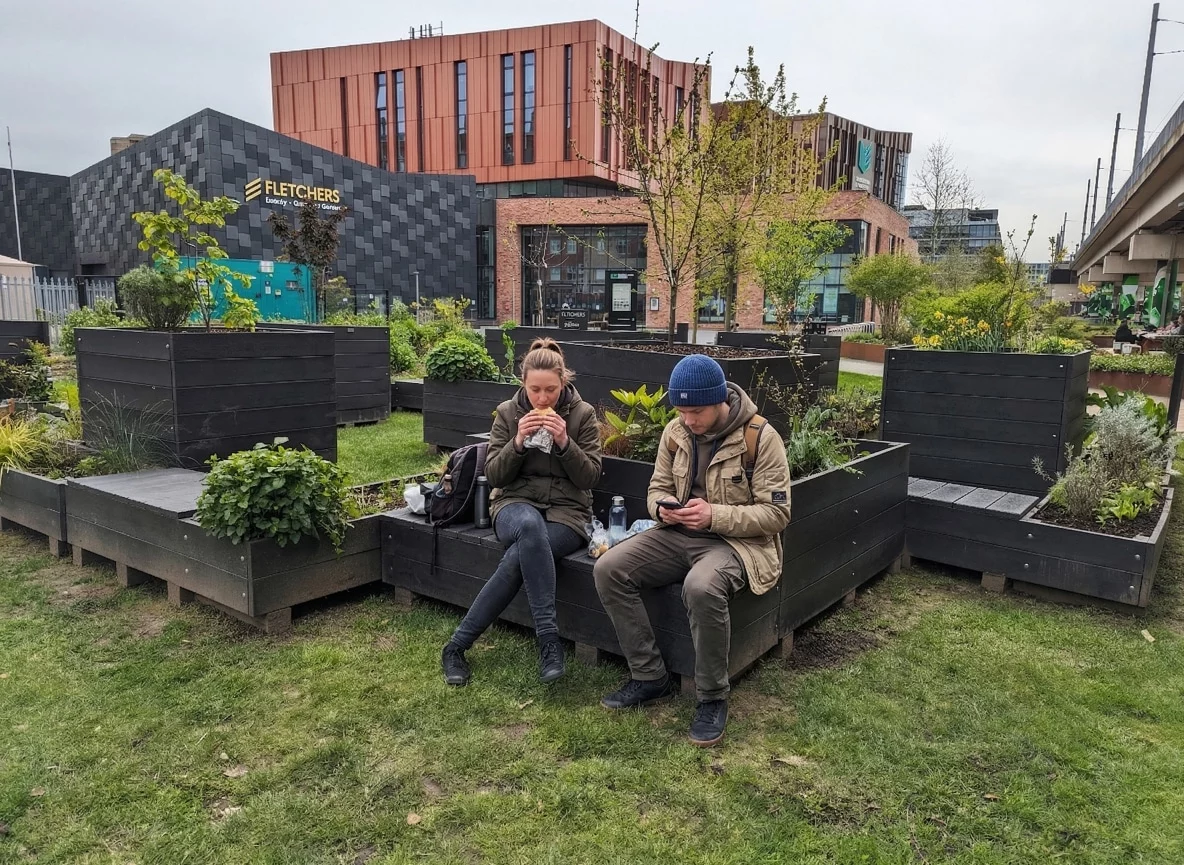
Many organisations overlook outdoor break spaces, missing a key opportunity to support employee wellbeing and meet health and safety standards like ISO 45003. Modular parklets made from recycled plastic provide a low-maintenance, durable solution that enhances staff recovery, supports biodiversity, and contributes to frameworks such as BREEAM. For Facilities Managers, they offer a practical, cost-effective way to deliver multiple operational and sustainability benefits in one investment.
- Most workplaces neglect proper outdoor break spaces
- ISO 45003 highlights the importance of restorative breaks for well-being
- Parklets transform unused areas into functional, social outdoor spaces
- Recycled plastic = no rot, no maintenance, 25+ year lifespan
- Lower total cost than timber over time
- Can contribute to BREEAM ratings and sustainability goals
- Quick, modular solution with strong multi-benefit return
When was the last time you actually looked at where your staff spend their breaks? Not the canteen, not the kitchen, but the moments when people step outside to clear their heads, get some air, and briefly disengage from the demands of the working day.
For a significant number of organisations, the honest answer is never. Staff congregate at a fire door, perch on a wall near the car park, or simply stay at their desks because there is nowhere worth going. It is a missed opportunity on several levels, and in the context of current health and safety best practice, it is increasingly difficult to justify.
The Compliance Case
ISO 45003:2021, the first global standard for managing psychological health and safety at work, requires organisations to identify and control psychosocial hazards with the same rigour applied to physical ones. Stress, poor recovery time, and the absence of genuine restorative breaks are all within scope. Improved employee well-being reduces absenteeism, improves retention, and directly supports productivity.
A well-designed outdoor break space is not a luxury addition to the estate; it is a tangible, auditable step towards meeting those obligations.
For organisations operating under ISO 45001, or those working towards it, ISO 45003 provides a direct integration pathway for psychosocial risk management. Facilities Managers who can point to considered, purposeful provision of outdoor rest space are in a stronger position than those who cannot.
And that’s where our parklets change the game.
What is a Parklet?
A parklet is a modular outdoor structure combining seating, planters, and decking. It’s configured to create a defined, usable space in areas that would otherwise go to waste. The concept originated in urban street design, where car parking spaces were repurposed into social spaces. But it translates naturally to commercial and public sector estates, where underused service yards, courtyard corners, rooftop terraces, and building perimeters often represent untapped potential.
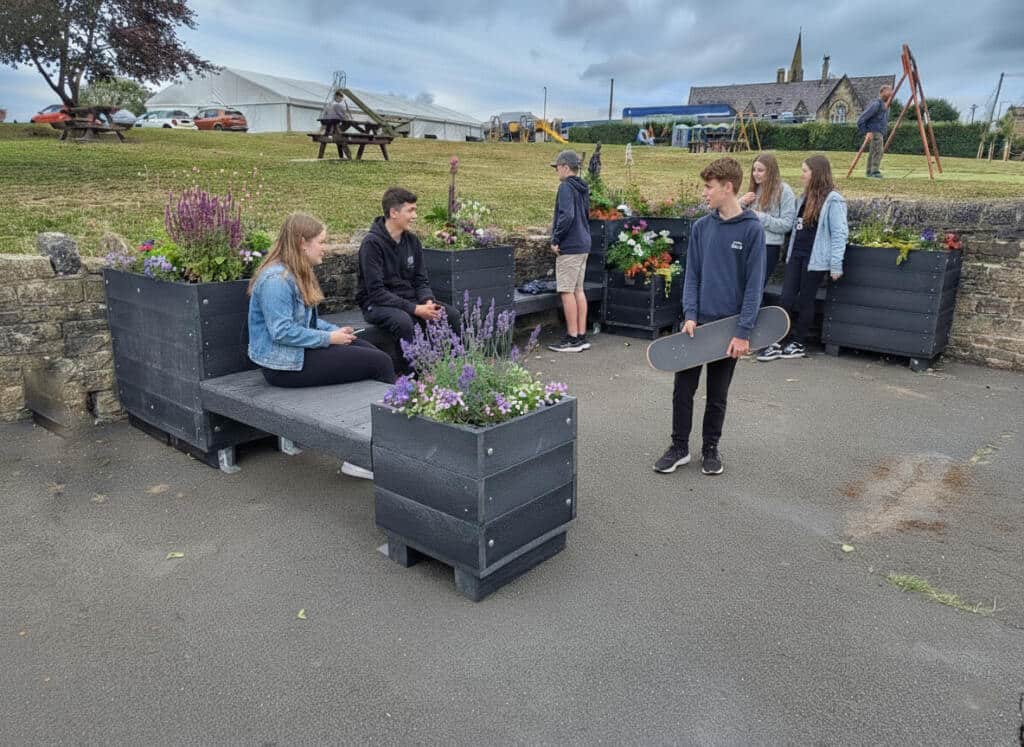
British Recycled Plastic’s Marsden range of modular parklets is built entirely from recycled polyolefin plastic, manufactured in the UK from British waste. The planters, seating sections, and decking components connect in L-shaped, rectangular, and square configurations, and can be scaled and recombined to suit almost any footprint.
Maintenance-Free Parklets
For Facilities Managers, the operational case is straightforward: Made from recycled plastic, our parklets are genuinely maintenance-free. They do not rot, split, warp, or require painting, staining, or preserving. They wipe clean and graffiti jets off easily. The material is UV-stable, so colour does not fade, and it is completely unaffected by frost, rain, or prolonged damp. We’re so sure of our product that every unit carries a 25-year guarantee.
Compare that with a timber equivalent, which will require regular treatment, is vulnerable to rot, and will need replacing well within the same timeframe, often more than once. When you calculate the total cost of ownership across a decade, recycled plastic is considerably more economical, and the ongoing demand on maintenance staff and budget is close to zero.
Biodiversity and BREEAM
Planted parklets do more than look attractive. Flowering plants and pollinator-friendly species provide nectar and habitat that directly support on-site biodiversity, which is now a measurable consideration for many organisations. Under BREEAM’s Health and Wellbeing category, access to outdoor spaces is a credited criterion. Under Land Use and Ecology, incorporating green spaces and wildlife habitats can contribute to a building’s rating. BREEAM also recognises that even buildings with limited landscaped areas can include ecological enhancement measures, with pollinator-friendly planting explicitly referenced as an eligible contribution.
If your building is subject to BREEAM In-Use assessment, or if you are planning a refurbishment that will trigger a reassessment, a planted parklet is worth raising with your assessor early in the process. The planters can support a wide range of planting, from flowering perennials and native shrubs to herbs and carbon-absorbing species such as ivy and ferns, depending on what best serves your site and your reporting objectives.
Helping You Design the Right Space
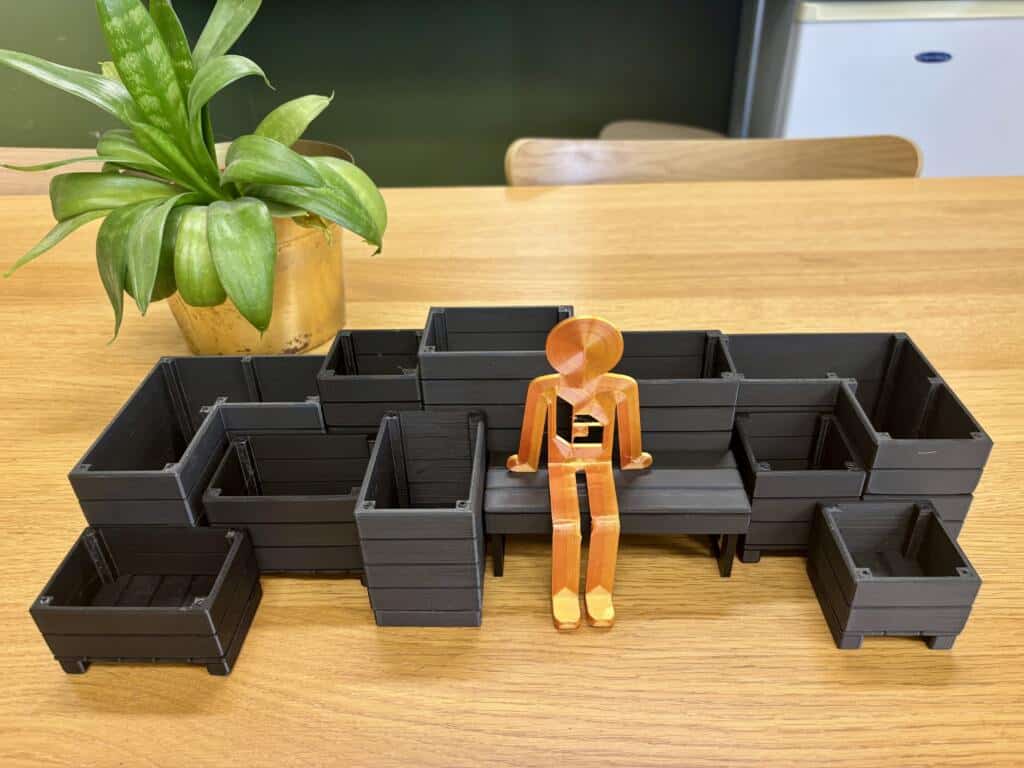
One of the practical challenges with any outdoor installation is visualising how it will actually look and feel in the available space before committing. We can help with that. Our team works with to-scale 3D models of the Marsden parklet components, allowing us to mock up configurations specific to your site dimensions and requirements. You can see how the seating, planters, and decking elements come together, understand the proportions relative to the surrounding space, and adjust the layout before anything is ordered or installed. It removes the guesswork and gives you something concrete to present internally when making the case for investment.
A Small Change With Significant Returns
A parklet does not require a major capital project or a lengthy procurement process. It is a modular, scalable addition to the estate that delivers against staff wellbeing, sustainability reporting, biodiversity, and maintenance efficiency in a single investment. For Facilities Managers juggling competing demands on budget and time, that kind of multi-benefit return is worth paying attention to.
If you would like to discuss your site and explore what configuration might work for your space, our team is happy to talk it through. You can reach us on 01422 419 555, [email protected], or browse the Marsden parklet range online.
Written by Jason Elliot
April 2026
Yes, our modular parklets have been successfully implemented in various urban projects, such as the Stockwood Pocket Park in Bristol. This initiative revitalised a high street area, creating a vibrant community space that underscores the effectiveness of our parklets in urban renewal.
Check out our video about the project here:
By transforming grey city areas into green oases, British Recycled Plastic modular parklets provide spaces that promote mental wellness and community engagement. They offer residents a place to connect with nature, relax, and interact with one another, fostering a sense of community and well-being
Absolutely. The modular nature of our parklets simplifies installation, and the use of recycled plastic ensures they are maintenance-free. Unlike traditional materials, they do not rot, split, or require regular upkeep, making them a cost-effective solution for urban spaces.
Yes, our modular design allows for flexibility in configuration and size, enabling adaptation to various urban settings. Components such as seating, planters, and decking can be arranged to meet specific community needs and spatial constraints.
By incorporating recycled materials, our parklets reduce environmental impact and promote eco-conscious living. They create green, immersive spaces that enhance biodiversity, improve air quality, and provide residents with areas for relaxation and social interaction
A British Recycled Plastic modular parklet is a versatile, prefabricated structure designed to transform urban spaces into accessible green areas. Constructed from durable materials, these parklets can be customised to fit various locations, providing seating, planters, and other amenities to enhance community engagement and environmental quality.