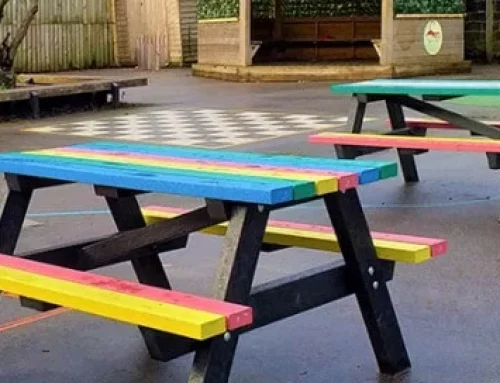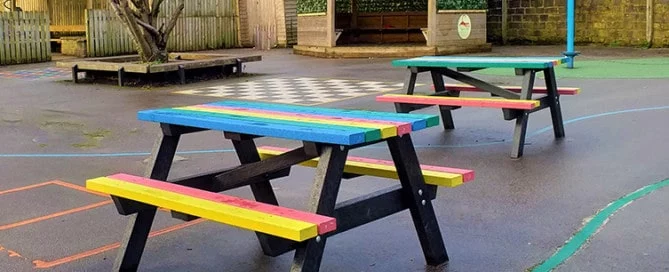

New research suggests artificial grass is one of the most significant land-based sources of microplastic pollution. As synthetic turf ages, both the plastic fibres and granular infill break down and escape into soil and waterways. While not all plastic products behave the same way, the key environmental question is how a material performs during use. Solid recycled plastic products such as benches, raised beds and picnic tables are dense, low-abrasion and far less prone to ongoing microplastic release.
Table of Contents
- Artificial grass is now recognised as a major source of microplastic pollution.
- The European Chemicals Agency estimates around 16,000 tonnes of microplastics are released from artificial turf across the EU each year.
- Research suggests a single artificial pitch can lose hundreds of kilograms to several tonnes of plastic material annually.
- The European Commission will ban the sale of granular polymer infill for synthetic sports surfaces from 2031 under REACH.
- Existing artificial grass installations will continue shedding microplastics long after new sales stop.
- Not all plastic products present the same risk: recycled plastic benches, raised beds, and outdoor furniture are comparatively low-wear, low-shedding applications.
- For landscape design, the important question is not simply “does it contain plastic?” but “what does it shed over its lifetime?
There’s a conversation happening around plastic in landscaping that isn’t quite the conversation it appears to be.
When most people picture microplastic pollution, they think of bottles, packaging, and single-use bags. But one thing that gets a lot less airtime is microplastic shedding. And one of the biggest culprits seems to have slipped under the radar entirely: artificial grass.
Artificial Grass & Microplastics: The Research
It’s worth being precise about what the research actually shows, because the picture has firmed up considerably in the last two or three years.
The European Chemicals Agency estimates around 16,000 tonnes of microplastics are released into the environment from artificial turf in EU countries every year. That figure puts synthetic grass among the largest land-based sources of microplastic pollution in Europe, alongside textile fibres from clothing and tyre wear from vehicles.
A systematic review published in Environmental Health Insights in 2024 went further still, concluding that artificial turf could account for somewhere between 12% and 50% of global microplastic pollution. The upper end of that range is contested, and reasonably so, but even the lower bound puts synthetic grass among the heaviest contributors of any single product category.

How Artificial Grass Sheds Microplastics
The mechanism is straightforward once you look at it. Artificial grass sheds in two parallel ways: The plastic blades themselves and the infill.
Artificial grass blades abrade and fragment under constant exposure to foot traffic, UV radiation, rainfall, and general weathering. The infill, typically crumb rubber, TPE, EPDM, or acrylic-coated sand, migrates off the surface through stormwater runoff, on shoes and clothing, and even through cleared snow.
Recent dynamic flow modelling from Norway estimates that each pitch can lose up to five tonnes of infill per year, with roughly half of that escaping into the surrounding environment. Beyond Plastics’ 2024 work in the United States found that each artificial turf field loses between 0.5% and 8% of its synthetic grass fibres annually, equating to somewhere between 90 and 1,450 kilograms of plastic waste per pitch per year.
So What’s Being Done?
The European response is already in motion. Under REACH, the European Commission will prohibit the sale of granular polymer infill for synthetic sports surfaces from 2031, covering crumb rubber, TPE, EPDM, and acrylic-coated sand. The Norwegian flow modelling makes an important caveat: A marketing ban is justified, but it is far from sufficient. Despite new sales stopping, existing pitches will continue shedding for decades to come.
This matters because it sits within a wider category of popular flexible, exposed and highly abrasive plastics. The polyester fleece in your jacket sheds an average of 7,360 fibres per square metre per litre of wash water. Standard polyester sheds at a much lower rate, around 87 fibres per square metre per litre. Acrylic, often marketed as a synthetic alternative to wool, is one of the worst offenders. A single study around the North Pole found that more than 73% of microfibre pollution there could be traced back to polyester resembling PET from textiles. Tyre wear is in the same conversation. So is artificial grass.
How Recycled Plastic Furniture Is Different
Now compare that with the recycled plastic we use to manufacture outdoor furniture, raised beds, picnic tables, and bollards. While we use the same family of polymers, it’s a fundamentally different application. The plastic has a solid, dense profile and isn’t being walked on millions of times a year as a wear surface. It isn’t being washed at sixty degrees in a domestic machine. It isn’t being torn between studded boots on a Saturday morning. The geometry, the density, and the use case all sit at the opposite end of the spectrum from the products that drive microplastic release.
This isn’t a claim that hard recycled plastic is environmentally invisible. Nothing is. But it is an honest distinction worth drawing. When the conversation about microplastics in landscaping begins, the question that needs asking is not “is there plastic in this product?” but “what is this plastic doing, mechanically, over its working life?”
A bench made from recycled HDPE with a 25-year guarantee, sitting in a school grounds or a country park, is doing almost nothing in microplastic terms. A 4G pitch of comparable surface area is shedding kilos of plastic into the watershed every year.
Water-Saving vs Microplastic Shedding
The industry is going to have to grapple with this properly. Specifiers, landscape architects, and procurement teams are increasingly being asked to account for microplastic release alongside embodied carbon, end-of-life, and water use. While there’s already talk about microplastics in gardening, synthetic grass has had a comfortable ride on the water-saving argument for a long time, and that argument was always doing a lot of work to obscure what was happening at the surface. The water case is real. The microplastic case is also real, and it’s catching up fast.
What we’d suggest, plainly, is that any landscaping conversation that involves plastic deserves the question put both ways. What does this product do while it’s in use, and what is it shedding while it does it. Recycled plastic furniture answers that question well. Artificial grass, on the current evidence, doesn’t.
If you’d like to understand more about microplastics and how our recycled plastic works, our friendly team of knowledgeable staff are available 5 days a week on email: [email protected] and phone: 01422 419 555.
Written by Jason Elliot
May 2026
-
Wash synthetic clothes less often or use microfibre filters.
-
Drive less to reduce tyre wear.
-
Choose durable, recycled plastic products instead of single-use or short-life materials.
-
Support the circular economy by buying products made from recycled plastic.
Every British Recycled Plastic product — from a school bench to a garden planter — helps keep waste in use, not in nature, and prevents new microplastics from forming.
The IUCN reports that synthetic textiles cause about 30% of ocean microplastics, and tyre wear contributes up to 10%. Other sources include paints, packaging films, and fishing gear.
Products from British Recycled Plastic are part of the solution, not the problem — they’re built to last decades, resist wear, and can be fully recycled again at the end of their long life.
Studies show traces of microplastics can build up in the human body over time, especially from synthetic fibres and airborne dust.
Using durable recycled products—like British Recycled Plastic furniture and lumber—helps reduce the amount of plastic that can fragment into dust or particles, contributing to a cleaner environment overall.
Microplastics have been detected in drinking water, seafood, salt, and even the air. They’re mainly absorbed from environmental pollution caused by disposable or fast-wearing plastics.
Because British Recycled Plastic’s materials are solid and sealed, they don’t release particles into the environment — helping to reduce the sources of this contamination.
Yes — research shows that microplastics can accumulate in marine life and enter the human food chain, with potential effects on health and ecosystems.
By creating long-lasting, sustainable recycled plastic products, British Recycled Plastic helps tackle this issue at its source: preventing plastic waste from breaking down and entering nature.
The main sources of microplastics are synthetic textiles, tyre wear, city dust, paints, and marine gear. These materials shed or fragment through friction, washing, or weathering.
In contrast, British Recycled Plastic’s long-life products—such as benches, picnic tables, and raised beds—are chemically stable and don’t flake or crumble, helping to reduce microplastic pollution by locking existing waste into durable, reusable items.
Microplastics are tiny plastic particles less than 5mm in size, formed when larger plastic items break down or when synthetic materials shed microfibres. They’re found in oceans, rivers, soil, and even the air.
British Recycled Plastic’s products are made from dense, solid recycled polymers that do not break down or shed, meaning they do not produce microplastics during use.